


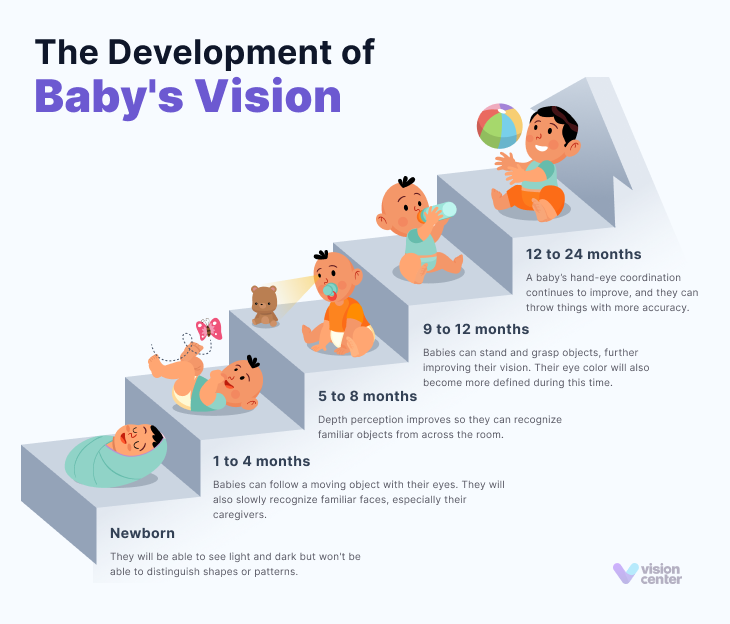
Your baby's vision develops fast, but not all at once. Newborns see blurry shapes and light, recognize faces within weeks, and start tracking color and depth by their first half-birthday.3 Knowing what to expect at each stage helps you spot the rare warning signs early, when treatment works best.8
This guide walks through what your baby should see month by month, the signs worth a call to your pediatrician, and when to schedule that first eye check.
What Does a Newborn See?
Newborns see light, shapes, faces, and movement, though everything beyond about 8 to 12 inches is blurry.3 That 8-to-12-inch range is roughly the distance from your baby's face to yours during feeding, which is exactly where they need to focus first.
Newborn eyes are also sensitive to bright light, so squinting or closing the eyes when a lamp clicks on is expected.2 Color perception is limited at first. Babies detect high contrast (black-and-white patterns grab attention) well before full color discrimination, which develops over the first several months.10
Listen In Q&A Format
What Should You Know About Your Babys Vision
Vision Center Podcast
1 Month: Tracking Light and Faces
By 1 month, your baby starts to focus on faces and follow a slowly moving object across their field of view.2 You'll see them lock onto your eyes during feedings and turn toward windows or lamps.
This is the stage where your face becomes the most interesting object in their world. Hold them close, talk to them, and let them stare. That visual back-and-forth is how the brain learns to process what the eyes are sending.1
2 to 3 Months: First Smiles and Eye Coordination
Around 2 months, the eye muscles begin working together more reliably, and your baby starts to smile at familiar faces.2 Occasional eye crossing or wandering in the first two months is normal because eye muscles are still calibrating.3
By 3 months, your baby should be tracking objects smoothly with both eyes and reaching toward things they see.2 If random eye wandering hasn't settled down by 3 months, let your pediatrician know. If one eye is consistently crossed or drifting in any direction, call your pediatrician rather than waiting for the next scheduled visit.4
4 to 6 Months: Color Vision and Depth Perception
Between 4 and 6 months, color perception sharpens and depth perception (the ability to judge how close or far an object is) develops.10 Babies start to reach accurately for toys, recognize a bottle from across the room, and notice subtle color differences.2
This is also when persistent eye misalignment becomes a real concern rather than a calibration issue.4 By about 6 months, both eyes should fixate and follow together, and most pediatricians will check eye alignment and the red reflex at well-child visits during this window.5
7 to 12 Months: Hand-Eye Coordination and Crawling
Between 7 and 12 months, your baby's eyes, hands, and body start working as a team. Crawling sharpens depth perception, and reaching, grasping, and dropping objects build hand-eye coordination.1
Your baby will recognize familiar people from across a room, follow your gaze toward objects you point at, and start to develop preferences for certain toys or faces. Their eye color may also become more defined during this period.
12 to 24 Months: Shapes, Faces, and Mirrors
By the time your baby is between 12 and 24 months, they can identify complex shapes and colors, throw and catch with more accuracy, and recognize themselves in a mirror.2 They'll point at familiar objects in picture books and may laugh at their own reflection.
Visual development is still happening behind the scenes. The brain is fine-tuning the connection between what each eye sees and how it puts the two images together, which is why early detection of any imbalance still matters at this age.8
Vision Red Flags at Every Stage
Most babies follow the milestones above with some normal variation, but a few signs warrant a call to your pediatrician or a pediatric eye specialist.4 Catching these early matters because the visual system is still wiring itself, and treatment works best when started young.8
Call your child's doctor if you notice:
- Persistent eye crossing or drifting after 4 months: a possible sign of strabismus, which can lead to amblyopia if untreated4
- Failing to track objects or make eye contact by 3 months: a possible developmental or visual issue4
- A white or grayish color inside the pupil (leukocoria): a serious finding (cataracts or other structural issues) that needs same-day evaluation4
- Extreme sensitivity to light or chronic tearing: sometimes glaucoma or a blocked tear duct7
- Pus, crust, or unusual discharge in either eye, or red swollen eyelids in a newborn: call right away; in a newborn, do not wait several days4
- Redness that does not clear within a few days in an older baby: often an eye infection, treatable with prompt care4
- Pupils of noticeably different sizes: worth checking with a pediatrician4
- A drooping eyelid that blocks the pupil: interferes with visual development and needs evaluation4
Strabismus and untreated refractive errors are the two most common causes of amblyopia, the condition where the brain learns to ignore input from one eye.8 Amblyopia is highly treatable when caught early, but the treatment window narrows as the visual system matures (typically by age 7 to 9), which is why pediatric eye checks start at birth.6, 8
Babies born very early or with very low birth weight need scheduled dilated eye exams to screen for retinopathy of prematurity (ROP), a condition that produces no visible early symptoms.9
When to Schedule the First Eye Exam
Pediatric eye checks begin at birth, with red-reflex and external eye exams at well-child visits.6 The American Optometric Association recommends a comprehensive infant eye exam between 6 and 12 months.1 Pediatric and ophthalmology guidance also calls for eye checks starting at birth, with a referral to an eye doctor sooner if a screening looks off, risk factors are present, or you spot a concern at home.6, 7
These are two complementary checks. The pediatric screening at well-child visits catches major abnormalities early. The comprehensive optometric exam at 6 to 12 months goes deeper into visual acuity, eye alignment, and focusing ability.5
The optometrist or pediatric ophthalmologist will check your baby's overall eye development and look for:
- Nearsightedness, farsightedness, and astigmatism
- Eye misalignment (strabismus)
- Amblyopia risk
- Drooping eyelids (ptosis)
- Cataracts and other structural issues
Some babies need an eye exam sooner than the 6-to-12-month window:
- If your pediatrician spots something at a well-child visit, schedule the referral promptly6
- If your baby was born premature or at very low birth weight, ask the NICU team or your pediatrician about the ROP screening schedule before leaving the hospital; eligible babies need a dilated eye exam within weeks of birth (usually between 4 and 9 weeks), not at 6 months9
- If there's a family history of childhood eye conditions, mention it at your next well-child visit and ask whether an earlier comprehensive exam is appropriate6
How to Support Your Baby's Vision at Home
Babies develop vision through everyday play and interaction. You do not need special equipment or expert routines, just consistent visual input that matches where their eyes and brain are in development.
Encourage Exploration
Offer new objects and textures your baby can touch, hold, and look at. Different shapes, weights, and patterns help connect what the eyes see with what the hands feel.
Provide Stimulating Visual Experiences
A crib mobile with bright colors and gentle movement gives newborns something to track at the right distance. High-contrast patterns (black and white, simple geometric shapes) are especially engaging before color vision fully matures. As your baby grows, add toys with varied textures, mirrors, and picture books.
Read and Tell Stories
Storybooks with bright illustrations and simple narratives stimulate visual development from the earliest weeks. As your baby gets older, point out objects in the pictures and name them so the visual and language systems develop together.
Take Them Outside
Outdoor time exposes your baby to varied distances, lighting, and movement, all of which support vision development. Describing what you see (the dog walking past, the leaves moving, the red car) helps your baby connect words to the world.
When to See an Eye Doctor
Most baby vision milestones happen on their own, but some warning signs need professional eyes on them. Call your pediatrician or schedule a pediatric eye exam if your baby is not tracking objects by 3 months, if one eye is consistently crossed or drifting at any age, if eye crossing or drifting persists after 4 months, if you notice a white or gray pupil, or if your baby was born premature or at very low birth weight.4, 6, 9
The earlier any vision issue is caught, the more options there are to correct it.8 For healthy infants, eye checks at well-child visits are routine from birth, and the AOA also recommends a comprehensive infant eye exam between 6 and 12 months.1, 5