

What are Smart Glasses?
Smart glasses, also called connected glasses, are embedded with internal and external sensors. These sensors add special functionality similar to what you find on a smartphone.
Depending on the brand, you can purchase smart glasses with and without prescription lenses.
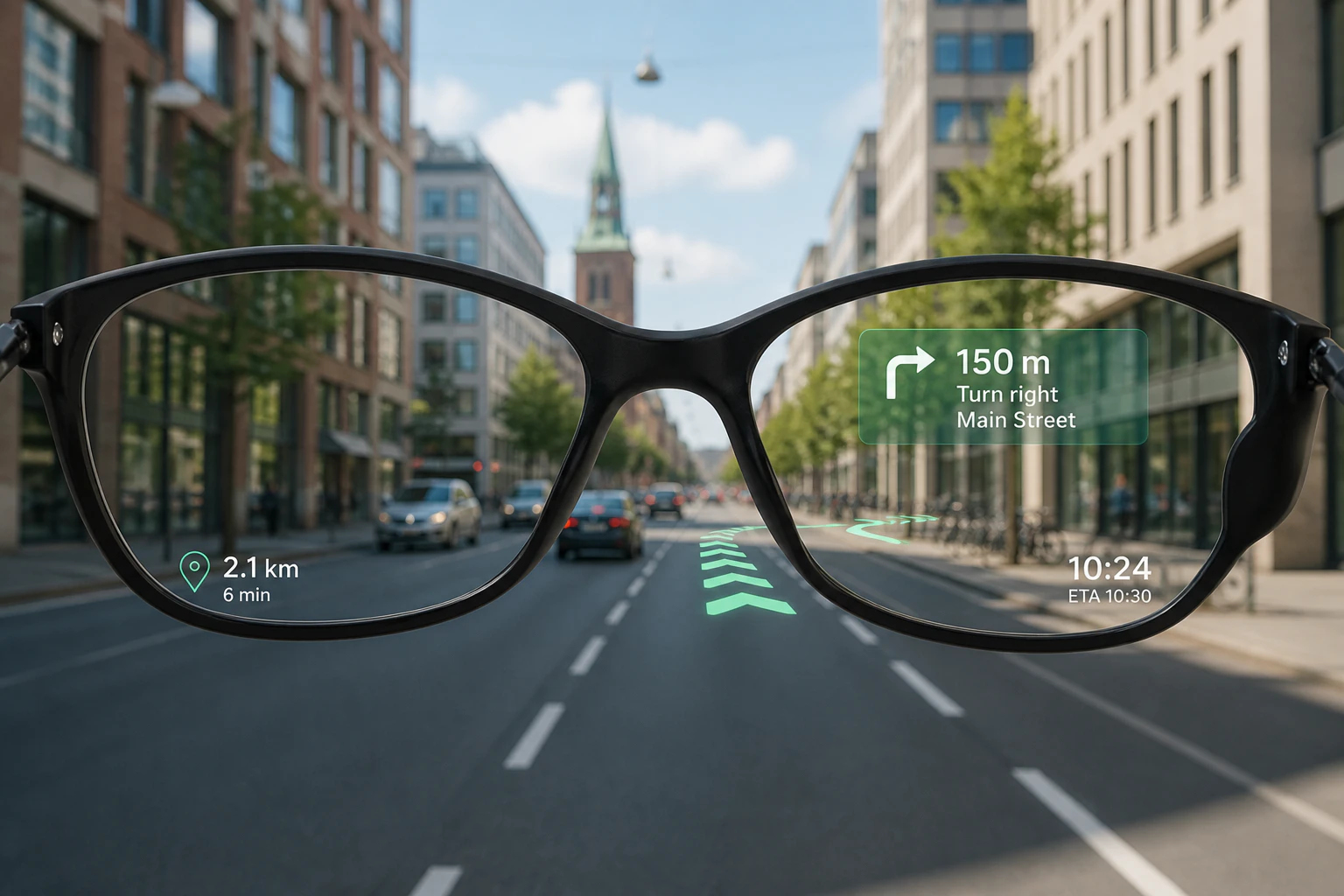
Smart glasses use wireless and Bluetooth technology to provide an enhanced user experience that includes:
- Listening to music
- Camera and video functionality
- Making phone calls
- Connection to the internet and smartphone
- Augmented reality (virtual objects overlaid in real-world environments)
Connected glasses have become increasingly mainstream in recent years. Major tech companies like Meta, Xreal, and Vuzix continue to invest in making smart glasses more practical for everyday use.
Everything We Recommend
- Best Overall: Ray-Ban Meta Wayfarer Smart Glasses
- Best For Augmented Reality: Vuzix M400 Smart Glasses
- Best For Lightweight AR: Xreal Air AR Glasses
Where to Buy Glasses + Contacts
Best Overall: Warby Parker
Fastest Delivery: EyeBuyDirect
Also Great: The Framery
Best Place to Buy Contacts: GlassesUSA
Top Smart Glasses With Prescription Lenses
Based on our research, here are the best smart glasses currently available:
1. Best Overall: Ray-Ban Meta Wayfarer Smart Glasses
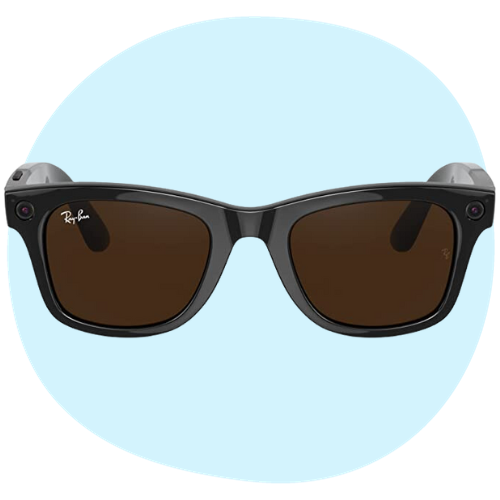
Ray-Ban Meta smart glasses are developed by Meta and feature the classic Ray-Ban Wayfarer design. They offer built-in AI assistance, live streaming, and hands-free photo and video capture.
The glasses integrate with Meta's ecosystem, allowing you to share content and interact with social media directly from your frames. They come in a variety of colors and lens options, including prescription and polarized lenses.
Pros
- Audio, photo, and video capability
- Built-in Meta AI voice assistant
- Ability to take phone calls
- Polarized and prescription lens options
- Can charge on the go with the included case
- Live streaming to Facebook and Instagram
Cons
- No augmented reality display
- Need a Meta account
- Battery life is limited with heavy use
Price: $299 on Amazon
2. Best For Augmented Reality: Vuzix M400 Smart Glasses for Enterprise Applications
The Vuzix M400 smart glasses put a small OLED display in front of one eye, so workers can follow instructions, join video calls, and check data without stopping what they're doing. They're built for work environments, with an auto-focus camera that doubles as a scanner, voice control in 29 languages, and hot-swappable batteries for long shifts.
Vuzix continues to be a leader in the enterprise smart glasses space, providing tools for remote assistance, training, and hands-free workflow management.
Pros
- OLED display that can sit over either eye
- Auto-focus camera with a built-in scanner
- Mounts on a headband or the included safety frames
- Strong enterprise support and app ecosystem
Cons
- Expensive
- No variety in styles
- Primarily designed for business use
- Vuzix doesn't sell prescription inserts for it
Price: $1,500 on the Vuzix website
3. Best For Lightweight AR: Xreal Air AR Glasses
Xreal Air glasses offer a lightweight, consumer-friendly approach to augmented reality. They project a virtual display in front of your eyes, making them ideal for watching media, working with multiple screens, or casual gaming.
Unlike bulkier headsets, Xreal Air glasses look closer to a standard pair of sunglasses. They connect to smartphones, laptops, and gaming consoles via USB-C.
Pros
- Large virtual display equivalent to a 130-inch screen
- Lightweight and comfortable for extended wear
- Compatible with multiple devices
- Prescription lens inserts available
Cons
- Requires a compatible device with USB-C video output
- Limited outdoor visibility
- Not a standalone device
How Do Smart Glasses Work?
Smart glasses utilize sensors, processors, and internet connectivity to bring smartphone technology to a pair of eyeglasses. Although each model works differently, smart glasses allow you to interact with them through a touch interface, voice commands, or head gestures.
Other smart glasses features include:
- Voice command to text
- Report generation
- Virtual reality (VR) or mixed reality (MR)
- Location identification
- Voice controls
- Improved battery life
- Eye tracking
Types of Smart Glasses
Smart glasses come in different shapes and sizes depending on the design and desired functionality. The different types of smart glasses include:
Monocular Smart Glasses
Monocular smart glasses contain an optical engine or device on one of the lenses. This allows your line of sight to be undisturbed by the visual interface.
Examples of monocular smart glasses include:
- Vuzix M400
- Vuzix Blade
- Lumus Sleek
Binocular Smart Glasses
Binocular smart glasses have an optical engine on both lenses. This provides stereoscopic (three-dimensional) vision. Binocular vision also augments a more significant part of the field of vision.
Most binocular smart glasses need to be connected to a smartphone or external device.
Examples of binocular smart glasses include:
- Xreal Air
- Epson Moverio
- Rokid Max
Audio Smart Glasses
Audio smart glasses use built-in speakers and microphones to deliver sound without covering your ears. They also have motion sensors and GPS capabilities for spatial orientation. Ray-Ban Meta glasses are the most well-known example of audio smart glasses, combining open-ear audio with camera and AI assistant features.
How Much Do Smart Glasses Cost?
Smart glasses vary in price depending on brand and features. Smart glasses designed for industry and the workforce are more expensive than those designed for the general population.
Smart glasses typically range from $199 to $1,500 and are widely available online. Additionally, some manufacturers can add a prescription to correct vision refractive errors.
Are Smart Glasses Worth It?
Although smart glasses and wearable devices have unique and interesting features, you might wonder if they're worth it. Here are some of the pros and cons of smart glasses:
| Advantages | Disadvantages |
|---|---|
| Ability to see phone apps from a binocular viewing angle | Prone to breaking |
| Hands-free phone usage | Not all smart glasses come with a prescription |
| Watch movies and consume online content | Requires a smartphone connection |
| Listen to music and audio | Requires wireless connectivity |
| Perform daily tasks while on the go | They can be expensive |
| Take high-quality pictures and videos | Privacy and other social concerns |
What Do Experts Think?
We spoke to a couple of experts to get their insights on smart glasses; here's what they think. Abhi Madan, a creative director at Amarra, mentioned that smart glasses provide a unique style, experience, and functionality.
However, whether they are worth it largely depends on how much you value the convenience and novelty of the tech. Similarly, Daivat Dholakia, the VP of Operations at Essenvia, thinks that smart glasses don't offer features your smartphone doesn't already have, which can make you wonder why you'd need a pair.
Regardless, both acknowledged that there are some privacy concerns regarding smart glasses. This is because smart glasses can discreetly film people in public or non-public spaces.
Why Trust Our Review?
We considered many factors when deciding which smart glasses fit best for each category.
Our decision criteria included the following:
- Research. Each product and brand came highly recommended by leading experts.
- Price and availability. Each product is affordable and easy to purchase online.
- Advanced features. Each product contained advanced features that proved safe and effective for daily use.
Summary
Smart glasses are wearable devices that provide basic smartphone tasks through eyewear. Typical functionality includes camera, video, augmented reality, and audio capabilities.
They connect to your phone via wireless and Bluetooth, offering a hands-free experience. There are also various options available on the market that provide different features and user experiences.
Although they offer unique features, some people may wonder if they're worth it, given that they don't offer any features that a phone doesn't already have. Additionally, there are some privacy concerns regarding their ability to record people discreetly.