


A prosthetic eye (also called an ocular prosthesis, artificial eye, or glass eye) is a custom-made shell that fits in the eye socket over an implant placed during eye-removal surgery. It restores a natural look but does not restore vision. Modern prostheses are made from medical-grade acrylic, last about 5 years on average before evaluation for replacement, and cost roughly $2,000 to $8,000 in the United States without insurance.
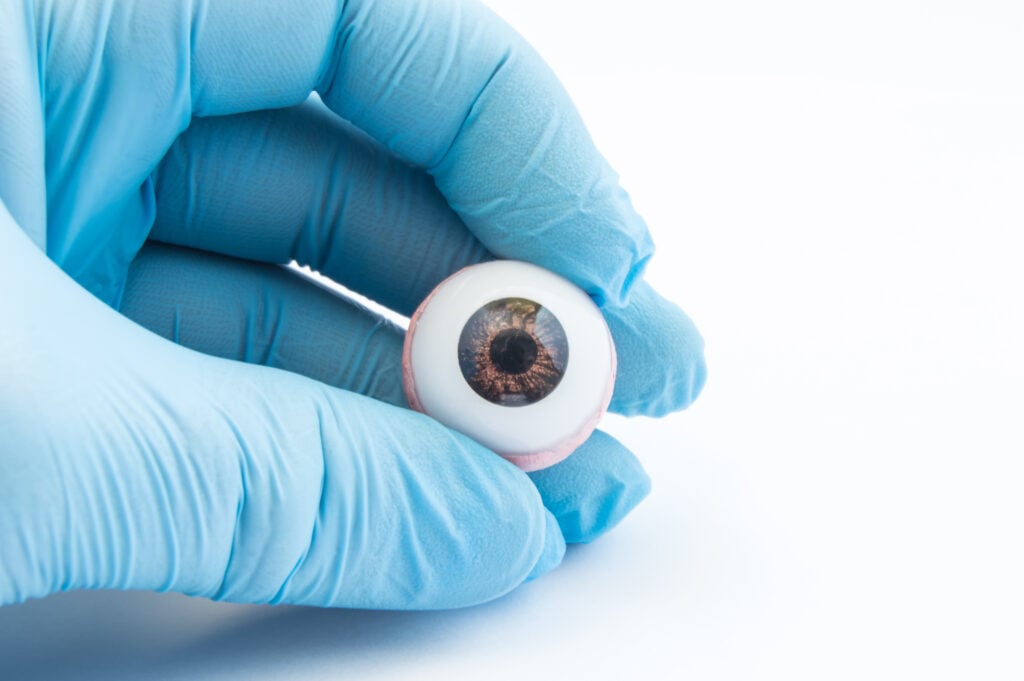
This guide covers what a prosthetic eye is, how the surgery and fitting work, what it costs, and how to care for it daily.
Common Questions About Prosthetic Eyes
What is the difference between a prosthetic eye and an artificial eye?
There is no medical difference: "prosthetic eye" and "artificial eye" are interchangeable names for the same device. "Ocular prosthesis" is the formal clinical term used by ophthalmologists. "Prosthetic eye" is the most common patient-facing term in the United States. "Artificial eye" is older terminology still used by some healthcare systems, including the UK's NHS. "Glass eye" refers to the historical material; modern prostheses are made of medical-grade acrylic, not glass.
Can a person see with a prosthetic eye?
No. A prosthetic eye does not restore vision. It is a cosmetic and protective device that covers an implant in the empty eye socket. The pupil is hand-painted and does not respond to light. Devices that aim to restore vision, such as retinal implants or the "bionic eye", are a separate, experimental category and are not prosthetic eyes.
How much does a prosthetic eye cost?
A prosthetic eye itself costs roughly $2,000 to $8,000 in the United States without insurance. That price does not include the eye-removal surgery, the orbital implant, or ongoing ocularist visits. Costs vary widely by ocularist, region, and insurance plan, and medical insurance (not vision insurance) typically covers a medically necessary prosthetic eye as durable medical equipment.
Is wearing a prosthetic eye painful?
Wearing a well-fitted prosthetic eye should not be painful once the socket has healed. Mild discomfort is normal during the first few weeks of fitting. Persistent pain, redness, or discharge is not normal. It usually signals an infection, a poorly fitted prosthesis, or socket irritation, and is a reason to see your ocularist or eye doctor promptly.
Do you sleep with a prosthetic eye in?
Yes. Most patients sleep with the prosthetic eye in place. Removing it too often can cause the eye socket to shrink and the prosthesis to lose its fit. Only remove it when your ocularist or doctor instructs, or for periodic cleaning.
What is a Prosthetic Eye?
A prosthetic eye is a custom-made acrylic shell that fits over an implant in the eye socket and recreates the appearance of a natural eye. It is shaped to match your remaining eye in color, size, and detail, including the iris, pupil, sclera (white of the eye), and even the fine blood vessels.
Common reasons someone may need a prosthetic eye include:
- Severe eye injury or trauma
- Ocular cancer treatment that requires removing the eye
- A painful, blind eye from advanced glaucoma or other end-stage disease
- A serious eye infection that cannot be controlled
- A congenital condition such as microphthalmia, in which the eye does not develop normally
A prosthetic eye is not a sphere like an eyeball. It is a thin, removable disc that sits in the socket over a separate orbital implant placed during eye-removal surgery (enucleation). The disc is custom shaped to match your other eye.
People have worn artificial eyes since the 1500s, when they were carved from glass. Modern prostheses are made from medical-grade acrylic, which is more durable, lighter, and easier to clean.
Scleral Shells: For People Who Still Have Their Natural Eye
Not everyone who needs a cosmetic eye device has had eye-removal surgery. People whose natural eye is intact but blind, shrunken (a condition called phthisis bulbi), or visibly disfigured can wear a scleral shell: a thin acrylic prosthesis that fits over the natural eye like a large contact lens. Scleral shells are made by ocularists and are cared for similarly to full ocular prostheses.
Who Makes a Prosthetic Eye?
Two specialists work together on a prosthetic eye:
- An oculoplastic surgeon: An ophthalmologist with subspecialty training in eye-socket and eyelid surgery who performs the eye-removal surgery (enucleation or evisceration) and places the orbital implant. Oculoplastic surgeons are usually members of the American Society of Ophthalmic Plastic and Reconstructive Surgery (ASOPRS).
- An ocularist: A specialist who makes and fits the custom prosthesis after the eye socket has healed. The ocularist handles long-term care, polishing, and replacement.
The two roles do not overlap. The surgeon is responsible for the socket. The ocularist is responsible for the prosthesis. Most patients see their surgeon for the first 2 to 3 months after surgery, then transition to the ocularist for everything that follows.
Ocularistry is not legally regulated in every state. When looking for an ocularist in the U.S., the two credentials to ask about are Board Certified Ocularist (BCO) (awarded by the National Examining Board of Ocularists) and ASO Diplomate (BADO), a membership tier of the American Society of Ocularists. Either signals advanced training beyond a basic apprenticeship.
How Does a Prosthetic Eye Work?
After eye-removal surgery, a spherical orbital implant or a tissue graft is placed in the socket to replace the volume of the removed eye. Some implants are porous (such as porous polyethylene, hydroxyapatite, or coral-derived calcium carbonate) and others are nonporous (such as silicone or acrylic); a dermis-fat graft from the patient's own tissue is another option. Your surgeon picks the material based on the procedure and your anatomy.
How the implant connects to the eye muscles depends on which surgery you had:
- In enucleation, the surgeon detaches the eye muscles from the removed eye and reattaches them to the implant (often through a covering of donor sclera or another wrap).
- In evisceration, the muscle attachments stay where they were: the implant is tucked inside the retained scleral shell, which keeps its natural muscle attachments.
The custom prosthesis fits in the socket over the implant and under the eyelids. Because the muscles still drive the implant, movement is transferred through the implant, socket tissues, and eyelids, allowing the prosthesis to move in sync with the natural eye. The result is a coordinated, natural-looking gaze. You can cry, shower, and (with caution and goggles) swim while wearing an ocular prosthesis.
A prosthetic eye does not restore vision, and the painted pupil does not respond to light.
How Much Does a Prosthetic Eye Cost?
A prosthetic eye costs $2,000 to $8,000 in the United States without insurance, but that price covers only the custom-made prosthesis itself, not the surgery or the implant. Plan for the following costs over the life of a prosthetic eye:
| Cost component | Typical range (US, without insurance) | Frequency |
|---|---|---|
| Eye-removal surgery (enucleation or evisceration) | $6,000 to $15,000 | One-time |
| Orbital implant (placed during surgery) | Usually billed with the surgery | One-time |
| Custom-made prosthesis from an ocularist | $2,000 to $8,000 | Every 5 years on average |
| Ocularist follow-up visits (fitting and polishing) | $150 to $400 per visit | Every 6 to 12 months |
Costs vary widely by ocularist, region, surgical team, and insurance plan. Medical insurance (not vision insurance) typically covers a medically necessary prosthetic eye as durable medical equipment. Medicare Part B covers artificial eyes that a clinician prescribes as medically necessary, including periodic polishing. Commercial plans vary, and many require pre-authorization for both the surgery and the prosthesis.
The U.S. Department of Health and Human Services, the Amputee Coalition, and some patient-advocacy organizations offer financial assistance for people without coverage. Your ocularist can also point you to local programs.
How the Surgery Works: Enucleation vs Evisceration
Two surgical options precede a prosthetic eye fitting:
- Enucleation removes the entire eyeball, including the sclera (white of the eye), and replaces it with an orbital implant. The implant is typically wrapped in donor sclera or another covering, and the eye muscles are reattached to it.
- Evisceration removes the inner contents of the eye but leaves the sclera (with its natural muscle attachments) in place. The implant sits inside that retained shell. It is less invasive than enucleation and has a faster recovery.
Surgeons choose between the two based on the underlying diagnosis, the condition of the eye, and trauma history. Evisceration has traditionally raised concern for sympathetic ophthalmia because some uveal tissue can remain in the socket, but documented cases are rare, and current reviews describe the comparative risk as uncertain rather than clearly higher. After severe trauma, many surgeons still prefer enucleation to reduce that concern. For the full surgical procedure, recovery timeline, and complication risks, see our enucleation surgery guide.
What is Recovery Like After Prosthetic Eye Surgery?
After surgery, your surgeon places a temporary clear plastic shell (called a conformer) behind your eyelid. The conformer holds the shape of the socket while it heals and prevents the eyelids from contracting. You wear it for several weeks.
About 6 to 8 weeks after surgery, you visit an ocularist for a prosthesis fitting. The ocularist takes an impression of your eye socket and creates a custom prosthesis that matches your remaining eye in color, size, and detail.
When the socket is fully healed (typically 3 to 4 months after surgery) the conformer is replaced with your finished prosthesis. A follow-up visit about a month later checks the fit and makes any adjustments.
Risks and Side Effects of Prosthetic Eye Surgery
The most common side effects of prosthetic eye surgery are temporary swelling, bruising, and mild eye-socket discomfort. Less common but more serious complications include infection, implant migration or extrusion, and (depending on the procedure and the situation) sympathetic ophthalmia.
Fitting discomfort typically resolves within 2 to 4 weeks as the socket adjusts. Infection is uncommon. Your surgeon may prescribe antibiotics, steroids, or pain medicine after surgery; whether antibiotics are used and how long you take them depends on the procedure, your infection risk, and your surgeon's preference.
Sympathetic ophthalmia is a rare autoimmune inflammation in the healthy eye that can develop after surgery or penetrating injury to the other eye. Most cases appear within the first several months, but it has been reported anywhere from days to decades after the inciting event, so any new vision change in the remaining eye is worth taking seriously, no matter how much time has passed. The overall risk is small (well under 1%) and the choice between enucleation and evisceration depends on the diagnosis, trauma history, and surgeon judgment.
When to See Your Ocularist or Eye Doctor
Schedule a same-day visit if you notice:
- Sudden eye-socket pain, especially with redness, swelling, or discharge, which can signal infection
- Vision changes in your healthy eye: New floaters, light sensitivity, pain, redness, or blurring at any time after surgery or a penetrating eye injury can be early signs of sympathetic ophthalmia or another urgent problem; don't wait if it has been months or years
- A cracked, chipped, or scratched prosthesis: Visible damage can irritate the socket lining
- Persistent watery discharge or yellow/green crusting: Common signs of socket infection
- A change in fit: If the prosthesis suddenly feels loose, tight, or sits at a different angle
For routine polishing, fit checks, and scheduled replacements, see your ocularist on the schedule below. For surgical or vision-related concerns, contact the oculoplastic surgeon who performed your eye-removal surgery.
How to Care for a Prosthetic Eye and Protect Your Remaining Eye
Tips for daily care:
- Cleaning. Wash the prosthesis with mild soap and water every 3 to 4 weeks. Never use alcohol-based cleaners. Let it air-dry; wiping with a cloth can leave behind fibers.
- Hand hygiene. Always wash your hands before touching the prosthesis. Dirty hands transfer bacteria into the eye socket.
- Sleep position. Most patients keep the prosthesis in place overnight unless their doctor instructs otherwise. Removing it too often allows the socket to shrink, which can change the fit.
- Lubrication. Use preservative-free artificial tears, or a lubricant your ocularist recommends, to keep the prosthesis comfortable during the day. Do not substitute contact-lens cleaning or disinfecting solutions; they are designed for soft lenses, not acrylic prostheses, and can damage the finish.
- Polishing visits. See your ocularist every 6 to 12 months for professional polishing. This removes surface deposits and extends the life of the prosthesis.
- Replacement. Plan on a replacement evaluation around the 5-year mark. Many prostheses last about 5 years, though some last longer with regular care, and some need replacement sooner if cracked, chipped, or poorly fitting.
- When to remove. Only remove the prosthesis for cleaning or when your doctor instructs. Frequent removal is the most common cause of socket changes that lead to a poor fit.
- Protect your remaining eye. Living with one seeing eye changes how much that eye matters; small injuries can have big consequences. Wear polycarbonate protective glasses during activities that carry any risk of impact (sports, yardwork, anything with flying debris). Keep up with regular dilated eye exams (most providers recommend yearly), and call your eye doctor right away for flashes, floaters, sudden blurring, or any drop in vision.
Summary
A prosthetic eye is a custom-made acrylic shell that fits over an implant in the eye socket after enucleation or evisceration surgery. It restores natural appearance but not vision. Budget for the surgery itself, the prosthesis, and ongoing ocularist visits every 6 to 12 months. Most medical insurance plans cover prosthetic eyes as durable medical equipment, but vision insurance does not.
Many prosthetic eyes last about 5 years before needing replacement, though some last longer with regular care. Once you are living with one seeing eye, that eye becomes your highest-priority piece of health equipment: wear polycarbonate glasses, keep your annual exams, and treat any new symptom in the remaining eye as urgent. If you have sudden socket pain, vision changes in your healthy eye, or visible damage to the prosthesis, see your ocularist or eye doctor the same day.